Balcony infill materials compared from a service-life perspective
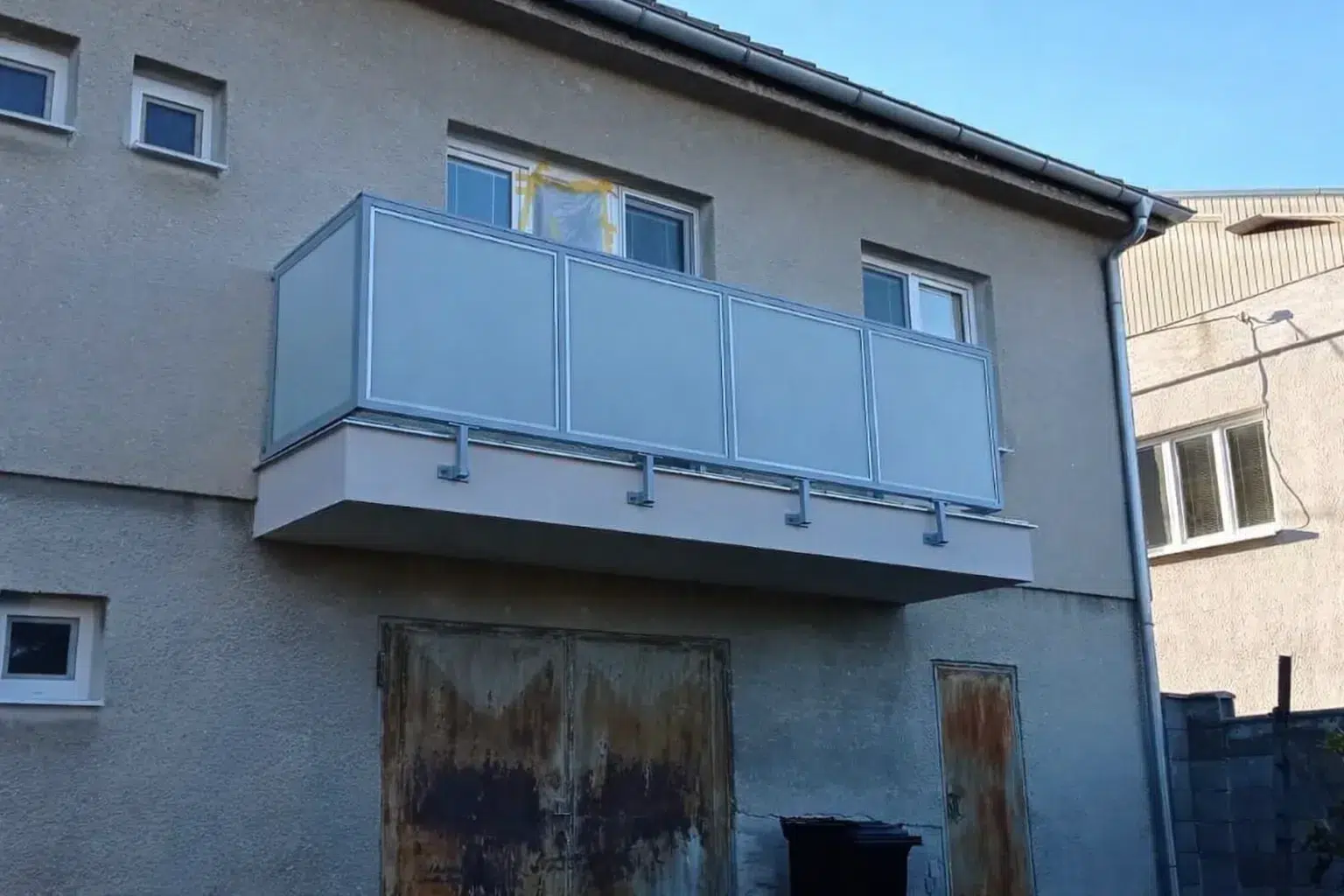
When choosing an infill for a balcony railing, it is not enough to compare colour, privacy and price per square metre. On an apartment building, the material will be exposed to rain, frost, summer heat, wind and airborne dirt. It is therefore important to understand how the infill ages, what cleaning it requires, whether a damaged panel can be replaced individually and what costs will arise over its entire service life.
Safety glass, aluminium composite panels, exterior-grade HPL and polycarbonate can all be suitable choices, but only when they form part of a properly designed system. A generic material name does not define its composition, thickness, finish, fixing method or suitability for a particular load. There is therefore no honest universal ranking in which one material will always “last the longest”.
This article builds on our introductory guide to glass, aluminium composite panels, HPL and polycarbonate in balcony railings. Here, the focus is on the life cycle: surface ageing, maintenance, inspection, replacement and long-term value for an owners’ association or property manager. It also distinguishes between the infill on a complete suspended balcony and a stand-alone railing replacement on an existing balcony slab or loggia.
The lifespan of a balcony infill is not a single number
The question “How many years will it last?” sounds simple, but it combines several different characteristics. An infill may remain mechanically functional while no longer meeting residents’ visual expectations. Another panel may still look good but require professional inspection following an impact, edge damage or a loose fixing.
At a minimum, compare the following four aspects:
- Safety and function: the infill, frame, anchors and connections must work as a system and be suitable for the intended use and design loads.
- Appearance: consider changes in colour, gloss and transparency, as well as scratches, stains, dents and the difference between an original and a replacement panel.
- Maintenance: cleaning frequency, safe access from the balcony and restrictions on cleaning products all matter.
- Repairability: the property manager needs to know whether one panel can be removed, ordered and replaced without interfering with the entire run of railing.
A figure quoted in the brochure for one product cannot therefore be applied automatically to a finished balcony railing. The actual result is influenced by the precise product range, panel dimensions, building orientation, edge details, allowance for movement, profiles, gaskets, fasteners, installation quality and subsequent care.
The complete design detail determines service life, not just the sheet material
Even a good infill can lose its appearance or function prematurely if it is installed without regard for its properties. The following details are particularly important in the technical design:
- Edges and holes: these must be machined and protected in the manner specified for the particular material. A damaged edge is often more vulnerable than the visible face.
- Thermal and moisture-related movement: sheet materials undergo dimensional changes. Fixings, clearances and spacing must not prevent this natural movement.
- Contact with the profile: the support must not create unsuitable point loads. At the same time, it should limit the accumulation of water and dirt.
- Drainage and junctions: standing water, blocked gaps or an incorrectly finished junction can also damage surrounding parts of the balcony.
- Removal for servicing: a well-considered frame allows one panel to be replaced without unnecessarily damaging adjacent elements.
For new aluminium balcony railings for apartment buildings, the infill is therefore selected together with the profiles and anchoring details. It is not a decorative sheet that can be assessed separately from the structural and guarding system.
How the different balcony infill materials age
Safety glass: a stable material with more visible signs of use
Glass does not corrode, and its transparency can preserve a light appearance across the façade. A clear surface, however, shows dried water marks, mineral deposits, dust and fingerprints more readily. In practical operation, the key question is not simply whether the glass can be cleaned, but whether both sides can be reached safely, including on upper floors.
A railing is not designed around an unspecified piece of “glass”. It requires a defined safety-glass build-up, dimensions, edge treatment and support method. The industry association Glass for Europe publishes an overview of European standards for laminated glass and laminated safety glass. The final specification must nevertheless always be determined by the authorised designer and system supplier for the particular building and loads.
An inspection should check for cracks, chipped or otherwise damaged edges, changes around the perimeter of a laminated build-up, and the condition of the supports and gaskets. A cracked panel cannot be repaired cosmetically. A replacement must match the technical specification, dimensions and appearance of the remaining panels. A properly documented project saves the property manager from having to guess the original glass build-up years later.
Aluminium composite panel: the precise product and its finish matter
An aluminium composite panel provides a lightweight, flat and opaque infill. In everyday use, attention focuses on the durability of its surface layer and edges, and on local susceptibility to scratches or dents. Darker and glossier surfaces can show dust, marks and fine scratches differently from light, matt finishes.
The terms aluminium composite panel or composite sheet are not sufficient specifications in themselves. A quotation should state the manufacturer, product range, composition, thickness, finish, classification for exterior use and fixing method. Differences between products can materially affect appearance, reaction to fire, permitted dimensions and maintenance. The dedicated ALUCOBOND product range for balcony applications is one example of why a precisely identified exterior-grade product should be assessed rather than treating an entire material group as if every product were identical.
If the frame construction permits it, replacing one damaged panel can be practical. The availability of the same colour and finish must still be checked. A new panel may look different beside panels that have been exposed for years, even when it carries the same colour code. It is therefore useful to retain the exact product designation, a sample and the supplier’s contact details from the time of handover.
Exterior-grade HPL: a robust panel that needs freedom to move
Compact HPL intended for exterior use provides an opaque infill, a choice of decors and the solid character of a sheet material. The result, however, depends on the specific exterior-grade product, not on the generic word laminate. Manufacturers’ technical guidance, such as the Fundermax Max Exterior documentation, demonstrates why machining, fixing and dimensional-movement rules must be followed.
Overly tight fixings, holes positioned too close to an edge or insufficient clearance are all potential failure points. The panel needs to move without unplanned stresses developing around its connections. An inspection should therefore cover not only the face, but also flatness, edges, cracks around holes and the condition of the fixings.
HPL should normally be cleaned gently, in accordance with the manufacturer’s instructions for the particular finish. Before selecting a large number of panels, inspect a physical sample in daylight. When a future replacement is needed, a discontinued decor range or differences between production batches can become an issue. Once again, precise records are more valuable than a description such as “grey HPL”.
Polycarbonate: low weight, but a more demanding specification
Polycarbonate may be solid or multiwall, clear, opal or tinted. These variants differ in stiffness, appearance, edge details and installation method. For exterior use, suitable UV protection, its correct orientation and sufficient allowance for the material’s comparatively high thermal expansion are essential.
The surface is generally more susceptible to scratching than glass. An unsuitable solvent, abrasive sponge or sharp tool can cause permanent damage. Use a gentle, non-abrasive cleaning method and only products permitted by the manufacturer of the specific sheet; generic cleaning advice for a different polycarbonate product may not account for its UV or surface layer.
With multiwall sheets, the correct sealing and ventilation of the cells must also be checked. Contamination or moisture inside the cells is harder to remove than dirt on the outer surface. A long-term comparison should therefore consider not only initial price and weight, but also the expected change in visual appearance, availability of a replacement and safe servicing.
Compare materials against the way the building will be used
Instead of relying on a single league table, ask the same practical questions about every option.
Cleaning and retaining the intended appearance
- Glass will usually show water marks and dust most clearly, although its smooth surface can be cleaned using a straightforward method when safe access is available.
- Solid sheet infills provide more privacy and, with a suitable decor, may visually disguise light soiling. Abrasive cleaning can nevertheless damage their finish.
- Polycarbonate requires particular care over cleaner compatibility and the use of soft cleaning tools.
- Accessibility determines the real maintenance burden for every material. An infill that cannot be cleaned safely will be difficult to manage, regardless of what its brochure claims.
Impact, local damage and replacement
- With glass, the safety build-up and the consequences of breakage are central. A damaged panel must be assessed by a specialist and replaced where necessary.
- An aluminium composite panel may remain permanently dented or scratched following a local impact even when it has not been pierced.
- HPL may withstand normal use well, but damage to edges and holes, or movement restricted by incorrect fixing, are critical concerns.
- A particular grade of polycarbonate may offer good impact resistance, while its visible surface remains more vulnerable to scratches.
The ability of the supplier to remove and safely reinstall a single panel is therefore central to servicing. A less expensive material will not save money if replacing one small damaged area requires extensive dismantling of the railing or costly access equipment.
Colour and material availability years later
On an apartment building, dozens of identical panels form part of one façade. If only one is replaced years later, a difference may be visible. Ask every tenderer to confirm the product designation, colour code, finish, colour tolerances and anticipated availability. Keep drawings, photographs, handover documents, maintenance instructions and, where possible, a reference sample in the building records.
A suspended balcony and a stand-alone railing require different approaches
On a complete suspended balcony for an apartment building, the infill is designed together with the new load-bearing structure, floor, drainage, profiles and surface finish. The manufacturer can coordinate the individual elements from the outset and develop a repeatable detail for the entire row of balconies.
With a stand-alone balcony-railing replacement, the existing balcony slab or loggia remains in place. Before selecting the infill, the substrate, geometry, slab edges, junctions with external insulation and anchoring options must be checked. Neither a new sheet nor new glass will remedy damaged concrete or an unsuitable frame. When planning related elements, also consider solutions for loggias, canopies and accessories.
If a building is undertaking both types of work at the same time—for example, new aluminium balconies on one façade and new railings on existing loggias on another—the colours and panel arrangement can be coordinated visually. They should nevertheless remain separate in the project, budget and programme. This makes it clear which work belongs to the new balcony structure and which forms part of the refurbishment of the existing building.
A glass railing infill is not the same as full balcony glazing. It fills the protective barrier up to its specified height, whereas balcony glazing uses a separate system to enclose the space above the railing. These terms must not be confused in an enquiry or quotation.
The building’s location changes the order of priorities
Assess the material in the environment of the specific façade:
- A heavily sun-exposed south- or west-facing elevation: check UV resistance, thermal movement, colour stability and the surface temperature of dark finishes.
- A busy road or dusty surroundings: cleaning frequency, appearance after rain and access to the outer face become important.
- Corners and upper floors: wind loads, panel formats, stiffness and reliable fixing carry greater weight.
- Balconies where privacy is a priority: compare opaque and matt solutions while also considering daylight inside the flats and the appearance of the complete façade.
- Areas with a higher risk of impact: the decision should account for the type of potential damage, whether the panel remains safe after the event and how quickly a replacement can be installed.
A photograph of another project may suggest an aesthetic direction, but it does not establish that a material is suitable for a different building. When browsing HS ALUSYSTEM project references, look at the complete balcony solution, the arrangement of the infill panels and their relationship with the façade. The final option should be confirmed only after a site survey and technical design.
What an owners’ association should require in comparable quotations
If owners are to decide on the basis of service life, every quotation must say more than the trade name of the material. Ask for:
- the manufacturer, exact product range and confirmation that it is intended for exterior use,
- material composition, thickness, finish and colour code,
- the dimensions and layout of the individual panels,
- the support and fixing method, edge treatment and allowance for dimensional movement,
- the technical information and evidence required for the specific application,
- cleaning and inspection instructions, including prohibited chemical and mechanical methods,
- the method for removing and replacing one damaged panel,
- warranty conditions that clearly distinguish between the material, finish and installation,
- availability of replacement parts and samples, and the expected colour match,
- the scope of dismantling, transport, installation, disposal and associated repairs.
Quotations can be compared fairly only when they cover the same scope. The price of the infill alone does not include profiles, machining, gaskets, fasteners, technical preparation or access equipment. Our guide to the factors that affect the cost of suspended balconies explains the wider budget context, while the HS ALUSYSTEM manufacturing process shows how design, machining, surface finishing and installation are connected.
Whole-life cost includes maintenance and future servicing
A simple whole-life cost model is useful for a property manager. Add safe cleaning, routine visual inspections, professional assessment following damage, replacement parts, transport and access equipment to the purchase price. Also allow for the risk that the same decor or product may no longer be available.
The lowest initial price does not necessarily deliver the lowest operating cost. The reverse is also true: a more expensive material does not automatically guarantee a longer service life if it is specified or installed incorrectly. Value comes from a coordinated system, high-quality installation and usable records.
The building’s handover archive should contain drawings, precise material designations, colour codes, technical data sheets, warranty terms, cleaning instructions, photographs and a service contact. The finish on the aluminium profiles also deserves dedicated care; practical guidance is available in our article on KOMAXIT powder coating for aluminium balconies.
A simple inspection plan after handover
The detailed plan should reflect the project documentation, manufacturer’s instructions and warranty conditions. A property manager can nevertheless establish a clear routine:
- archive the documentation and photograph the as-built condition at handover,
- clean the infills gently at the recommended intervals and visually inspect the surfaces, edges, connections and gaskets at the same time,
- arrange an inspection of the affected area after a severe impact, extreme winds or another exceptional load,
- do not tighten or modify cracked or loose components without instructions from the supplier,
- record and photograph each finding and compare it with the previous condition,
- if a change could affect safety, restrict use of the area and call a specialist.
This record helps distinguish ordinary soiling from progressive deterioration and speeds up warranty claims or servicing. It also preserves information that is often lost when the committee or property manager changes.
Choose the infill as part of a made-to-measure system
A sound decision cannot be reached by voting for a material name without its technical context. Start by defining the building’s priorities: safety, privacy, daylight, appearance, maintenance, impact risk and budget. Then compare specifically defined options on an equal basis and review physical samples.
HS ALUSYSTEM designs, manufactures and installs balconies for apartment buildings and aluminium balcony railings as solutions tailored to each property. In your enquiry, state whether the project concerns complete suspended balconies, balcony refurbishment or a stand-alone railing replacement, and include the number of panels, photographs of the façade and the owners’ requirements.
Contact HS ALUSYSTEM to request a comparison of suitable balcony infill materials for your apartment building. The team will review the information, recommend the next step and help prepare options that can be compared both technically and in terms of long-term performance and maintenance.
Frequently asked questions
Which balcony infill material has the longest lifespan?
There is no responsible answer without identifying the specific product and system. Service life is influenced by material composition, suitability for exterior use, dimensions, edges, fixing method, façade orientation, installation and maintenance. Compare technically specified glass, aluminium composite panels, HPL and polycarbonate rather than generic material names.
What should be checked on balcony infill panels?
Check the visible face, edges, cracks, scratches, dents, changes in colour or transparency, flatness, supports, connections and gaskets. For multiwall polycarbonate, also inspect the condition of the cells. Any change that may affect safety or fixing integrity should be assessed by a specialist.
Can a damaged infill panel be replaced individually?
It often can when the railing has been designed for servicing. The frame construction, access, fixing method and availability of the same material all matter. Ask the tenderer to describe the removal of one panel, and retain the precise specification and a colour sample after handover.
Is a glass infill maintenance-free?
No. Glass does not corrode, but water marks, mineral deposits and dust are often visible on a clear surface. It requires gentle cleaning with safe access. The edges, supports and gaskets must also be inspected in accordance with the system documentation.
Does the choice differ for a new suspended balcony and a railing replacement?
Yes. On a new suspended balcony, the infill is coordinated with the new load-bearing structure, floor, drainage and profiles. For a railing replacement, the existing slab, substrate, geometry and anchoring are assessed first. A suitable material can be chosen in both situations, but the technical brief is not the same.